
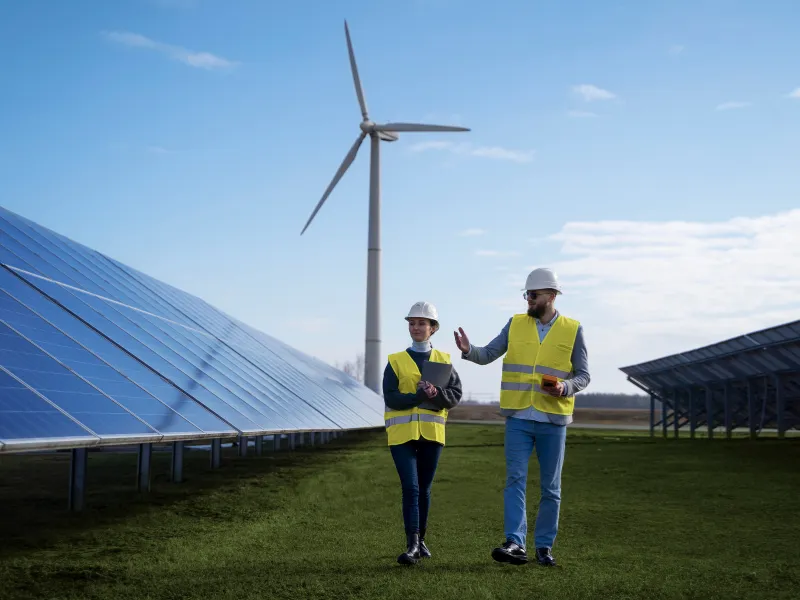
The average American homeowner spends over $1,500 a year on electricity and that number keeps rising. Clean solar energy has become one of the most practical ways to take control of that cost, with most residential systems paying for themselves within 6 to 12 years and lasting 25 to 30 years beyond that. Whether you’re comparing panel types, trying to understand your incentive options, or just starting to research, this guide covers everything you need to make a confident, informed decision.
How Clean Solar Energy Works (Step-by-Step)
Solar power generation is simpler than most people expect. Here’s how it works from sunlight to the outlet in your wall:
Step 1 — Sunlight hits the panels. Each solar panel contains dozens of photovoltaic (PV) cells made from silicon. When sunlight strikes these cells, it knocks electrons loose, creating an electric current.
Step 2 — Direct current (DC) is produced. The current generated by PV cells is DC electricity — the same type stored in batteries, but not directly usable by your home appliances.
Step 3 — The inverter converts DC to AC. A solar inverter transforms DC electricity into alternating current (AC), the standard form your home’s outlets and appliances use.
Step 4 — Power flows through your home. Your home uses solar electricity first, before drawing anything from the utility grid.
Step 5 — Excess energy is stored or exported. If your system produces more than you’re using, excess electricity either charges a battery (like a Tesla Powerwall or similar) or is sent back to the grid earning you credits through a program called net metering.
The entire process produces zero emissions during operation, requires no fuel, and works in both hot and cold climates as long as there is adequate sunlight exposure.
Key Components of a Residential Solar System
A complete system includes four main parts, each playing a specific role:
- Solar panels — Capture sunlight and generate DC electricity
- Inverter — Converts DC to usable AC electricity (string, microinverter, or power optimizer types)
- Battery storage (optional) — Stores excess energy for use at night or during outages
- Mounting system — Secures panels to your roof or ground at the optimal angle
Types of Solar Panels: Which One Is Right for You?
Not all solar panels are the same. Choosing the right type affects your system’s output, the roof space required, and your long-term return on investment.
Monocrystalline Panels
Monocrystalline panels are cut from a single silicon crystal, which gives them the highest efficiency of any residential panel type typically between 20% and 24% in 2026. They perform well in limited roof space and maintain stronger output in low-light conditions. Most homeowners who want maximum output from a standard-sized roof should consider these.
Best for: Homeowners with limited roof space or high energy consumption, and if you’re also looking to access it visit here and avail it now for discounted price.
Polycrystalline Panels
Polycrystalline panels are made from fragments of multiple silicon crystals melted together. They are slightly less efficient (typically 15%–17%) and occupy more roof space for the same output, but they cost less upfront. As monocrystalline prices have dropped significantly in recent years, polycrystalline panels have become a less compelling trade-off for most buyers.
Best for: Buyers on a tight budget with ample roof space.
Thin-Film Panels
Thin-film panels are lightweight and flexible, making them suitable for non-traditional surfaces like curved roofs or commercial metal buildings. Their efficiency is generally lower (10%–13%) and they degrade faster over time, making them a poor fit for most residential applications.
Best for: Commercial installations, flat industrial roofs, or specialty applications.
2026 Technology Update: What’s Actually Changed
The most significant development in 2026 is the growing adoption of N-type TOPCon and back-contact cell architectures, driving innovation in green energy solutions. Premium back-contact modules are now approaching 25% efficiency in commercial production, while N-type TOPCon panels which are more scalable to manufacture consistently exceed 24% efficiency and represent the dominant high-volume platform. For most homeowners, a high-quality monocrystalline panel using N-type cell technology offers the best balance of performance, durability, and price.

Best Solar Panels for Residential Use in 2026
Based on efficiency ratings, warranty terms, temperature performance, and long-term degradation rates, here are the top-performing residential panels available this year:
| Brand & Model | Efficiency | Warranty | Best For |
| REC Alpha Pure-RX | Up to 23.9% | 25-year product & performance | Best overall: low degradation, excellent temp coefficient |
| Q Cells Q.PEAK DUO | Up to 22.3% | 25-year product & performance | Best value: strong performance at competitive price |
| Hyundai HiE-S | Up to 22.1% | 30-year performance (glass-glass) | Best longevity: rare 30-year warranty |
| Canadian Solar HiKu7 | Up to 22.5% | 25-year product & performance | Best for large installations |
| Silfab Prime | Up to 22.0% | 30-year product & performance | Best for North American manufacturing |
Quick note on brand choice: REC and Q Cells panels consistently rank as the top two choices among homeowners when given multiple options, because both deliver premium efficiency at accessible price points. Hyundai’s glass-glass bifacial design is worth considering for anyone planning to stay in their home long-term, given its rare 30-year performance warranty.
Environmental Benefits of Clean Solar Energy
Zero Operational Emissions
Once installed, a solar panel system produces no greenhouse gas emissions whatsoever. The only emissions associated with solar come from manufacturing and installation and research consistently shows that most silicon-based panels reach “energy payback” the point at which they’ve generated more energy than was used to produce them within one to four years. Against a 25 to 30 year operating lifespan, that’s an overwhelmingly positive environmental ratio.
Minimal Water Use
Traditional fossil fuel power plants consume enormous quantities of water for cooling. Solar photovoltaic systems require virtually none during operation, a significant advantage in drought-prone regions.
Innovative Applications: Floatovoltaics
One emerging application placing solar panels on reservoirs and water treatment facilities (called floatovoltaics) serves a dual purpose: the water cools the panels during peak heat, improving efficiency, while the panels reduce water evaporation from the surface beneath them. These installations are now active across several U.S. states and parts of Europe.
Carbon Footprint Reduction
A typical 6 kW residential solar system offsets approximately 5 to 6 metric tons of CO₂ annually roughly equivalent to planting 130 to 140 trees per year, every year the system operates.
What Does Solar Installation Actually Cost in 2026?
Before incentives, a typical residential solar installation ranges from $15,000 to $30,000, depending on system size, panel brand, roof complexity, and regional labor rates. Here’s a realistic breakdown:
| System Size | Typical Cost (Before Incentives) | Best Suited For |
| 4 kW | $12,000 – $16,000 | Small homes, low energy use |
| 6 kW | $18,000 – $22,000 | Average U.S. household |
| 8 kW | $24,000 – $30,000 | Larger homes or EV charging needs |
| 10 kW+ | $30,000+ | High-consumption homes |
Financial Incentives: What You Can Claim
Federal Solar Tax Credit (ITC)
The federal Investment Tax Credit (ITC) has historically allowed homeowners to deduct a significant percentage of their installation cost from federal taxes. Verify the current credit percentage with a tax professional or via the IRS website, as rates may have changed from the 2025 phase-down schedule.
State and Local Incentives
Many states offer additional rebates, sales tax exemptions on solar equipment, and property tax exemptions that prevent a solar installation from raising your assessed home value and therefore your property tax bill. The Database of State Incentives for Renewables and Efficiency (DSIRE) at dsireusa.org is the most reliable and up-to-date source for what’s available in your state.
Net Metering
Net metering programs allow you to sell surplus electricity back to your utility at a credit rate, effectively using the grid as a battery. Availability and credit rates vary widely by state and utility always confirm your local net metering policy before sizing your system.
Return on Investment
For the average homeowner, residential solar delivers a return on investment of 10% to 20% per year, with full payback typically achieved within 6 to 12 years. Given that most panels last 25 to 30 years, the majority of a system’s lifetime output is essentially free electricity. Solar installations also consistently increase home resale value, a meaningful benefit even if you sell before the payback period ends.
Read more here to compare solar costs against off-road diesel fuel
The Solar Installation Process: Step by Step
Understanding what to expect helps you choose the right installer and ask the right questions.
1. Site assessment (Week 1). A qualified installer evaluates your roof’s orientation, angle, available square footage, shading from trees or neighboring buildings, and structural integrity. A south-facing roof with minimal shading between 9 a.m. and 3 p.m. will produce the most energy. East- and west-facing roofs are still viable but with some output reduction.
2. System design and quote (Weeks 1–2). Based on your energy bills and roof assessment, the installer designs a system sized to offset your target percentage of electricity consumption and provides a detailed quote.
3. Permit applications (Weeks 2–5). Your installer submits permit applications to your local authority having jurisdiction (AHJ) and, in most cases, coordinates a utility interconnection agreement. Permitting timelines vary significantly by city and county.
4. Installation (1–3 days). The physical installation of mounting hardware, panels, wiring, inverter — typically takes one to three days for a standard residential system.
5. Inspection and utility approval (Weeks 1–4 after install). A local inspector approves the installation, and your utility company authorizes the system to connect to the grid and enables net metering if applicable.
6. Monitoring and first bill. Most modern inverters include app-based monitoring so you can see exactly how much energy your system produces in real time.

Maintaining Your Solar System
Solar panels are among the lowest-maintenance energy systems available, but a few routine tasks keep them operating at peak efficiency:
- Clean panels twice a year — dust, bird droppings, and pollen reduce output over time. In most climates, rainfall handles most cleaning naturally; a twice-yearly manual cleaning with water and a soft brush covers the rest.
- Annual professional inspection — a technician checks wiring, mounting hardware, and the inverter for any signs of wear or underperformance.
- Inverter lifespan — string inverters typically last 10 to 15 years, meaning most homeowners will replace one during the life of their panel system. Microinverters generally carry 25-year warranties matching the panels themselves.
- Battery storage maintenance — if your system includes battery storage, follow the manufacturer’s maintenance schedule; most lithium-based batteries degrade to around 70%–80% capacity over 10 years.
How to Choose a Solar Installer
The quality of your installation matters as much as the quality of your panels. Here’s what to look for:
- Licensing and insurance — Your installer must hold the relevant state contractor’s license and carry both general liability and workers’ compensation insurance. Never hire an unlicensed installer.
- NABCEP certification — The North American Board of Certified Energy Practitioners (NABCEP) certification is the solar industry’s most respected professional credential. Ask whether the installer or their lead technician holds it.
- Local experience — Permitting requirements, utility interconnection rules, and optimal system configurations vary by region. An installer with proven local experience navigates these faster and avoids costly errors.
- Verified references — Ask for references from customers with similar roof types and system sizes in your area, and follow up on them.
- Detailed written quote — A professional installer provides an itemized quote covering equipment, labor, permitting fees, and projected energy production not a vague lump-sum number.
- Get at least three quotes — Pricing varies significantly between installers. Three quotes gives you a realistic sense of market rate and negotiating leverage.
Community Solar: A Viable Alternative
Not every home is suitable for rooftop panels. Shading, roof orientation, lease restrictions, or structural limitations can rule out a private installation. Community solar programs offer a practical alternative: you subscribe to a share of a larger, off-site solar installation and receive credits on your monthly utility bill for your share of the energy produced.
Community solar is particularly valuable for renters, condo owners, and homeowners with north-facing or heavily shaded roofs. Programs vary by state, search “community solar [your state]” to find options available in your area.
Frequently Asked Questions
What makes clean solar energy “clean”?
Solar panels generate electricity through a photochemical process, not combustion. There is no burning of fuel, which means no carbon dioxide, nitrogen oxides, or particulate matter is released during operation. The only emissions associated with solar panels occur during their manufacture and those are offset within one to four years of operation.
How long do solar panels actually last?
Most tier-one manufacturer panels carry a 25-year performance warranty guaranteeing at least 80% of original output at year 25. In practice, many panels continue generating meaningful power well beyond that. Degradation rates for premium N-type panels are now around 0.25%–0.35% per year, which means a 25-year-old panel still performs at over 90% of its original capacity.
Do solar panels work on cloudy days?
Yes solar panels generate electricity from diffuse light, not just direct sunlight. On a heavily overcast day, a well-sized system typically produces between 10% and 25% of its clear-sky output. Countries like Germany and the UK far cloudier than most of the U.S. — have some of the world’s highest per-capita solar adoption rates, demonstrating that cloud cover is a manageable limitation, not a dealbreaker.
What is the difference between grid-tied and off-grid solar?
A grid-tied system connects to the utility grid and can both draw power from it (at night or on very cloudy days) and export surplus energy back to it via net metering. An off-grid system operates entirely independently, relying on battery storage for power when the sun isn’t shining. Off-grid systems cost significantly more due to battery requirements and are typically chosen for remote properties without grid access.
What happens to solar panels after 25–30 years?
Solar panels can be recycled, though the industry infrastructure for doing so is still developing. Most panels consist of glass, aluminum, silicon, and small amounts of silver — all recoverable materials. Several manufacturers now offer take-back and recycling programs. The U.S. is expected to see a significant increase in panel recycling capacity over the next decade as the first large-scale residential installations reach end of life.
Is solar worth it if I’m planning to sell my home?
Research consistently shows that solar installations increase home resale value. A Lawrence Berkeley National Laboratory study found that buyers pay a premium of roughly $4 per watt of installed solar capacity meaning a 6 kW system could add approximately $24,000 in home value. Even if you sell before your personal payback period ends, you may recover much of the installation cost through a higher sale price.
What is net metering and does my state have it?
Net metering is a billing arrangement where your utility credits you for the excess electricity your system sends to the grid. If your panels produce more than you consume in a billing period, those credits offset future bills. Net metering policies differ significantly by state and utility; some offer full retail-rate credits, others offer lower wholesale rates. Check your state utility commission’s website or DSIRE for current rules.
Summary: Is Solar Right for You?
Clean solar energy makes the most financial sense when you own your home, have adequate south or southwest-facing roof space with minimal shading, pay above-average electricity rates, and plan to stay in the property for at least 8 to 10 years. The combination of declining panel costs, available incentives, and rising utility rates has made solar a sound investment for millions of U.S. homeowners and the technology and warranty terms keep improving.
The best next step is to get two or three quotes from NABCEP-certified local installers, compare projected production estimates, and review what state-level incentives are currently available in your area through dsireusa.org.